
TL;DR
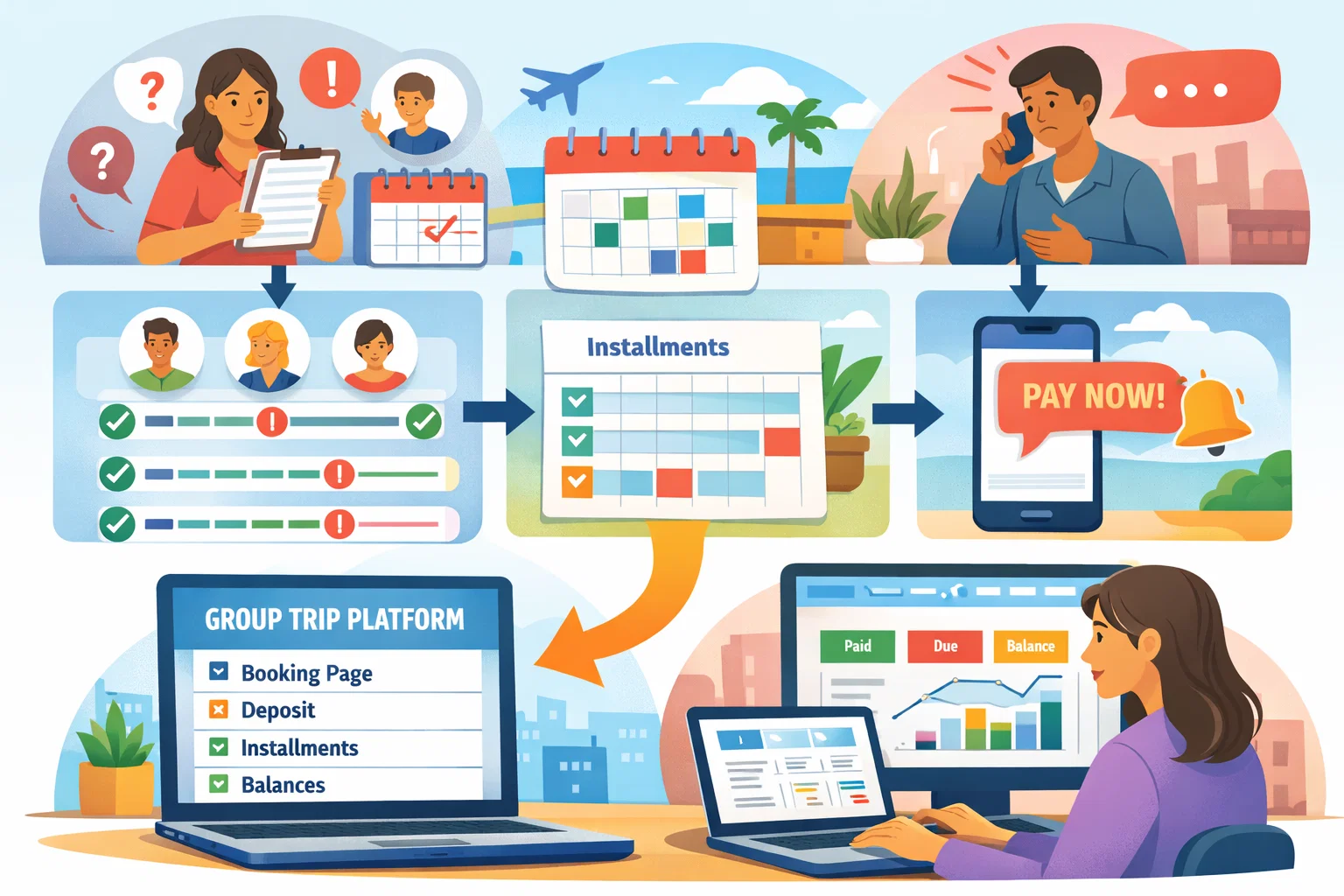
- Collecting money manually leads to confusion, missed payments, and awkward follow-ups.
- Venmo, Zelle, and Cash App move money between people; you can't use them to charge a deposit at booking or installments on your schedule.
- Clear payment deadlines and structured installment plans reduce drop-offs.
- Separate tracking for each traveler prevents accounting errors, and automated reminders increase on-time payments.
- SquadTrip lets you create booking pages, collect deposits, and run automatic payment plans. SquadTrip's Starter plan is free, and travelers pay a single 6% processing fee on top of the trip price, so the organizer receives the full price.
Introduction
The most reliable way to collect money for a group trip is to use a centralized payment platform like SquadTrip: one booking page where every traveler registers, pays a deposit, and moves onto an automatic payment plan. Avoid Venmo or Zelle for groups over 5 people — there's no booking page, no way to charge installments, and disputes become personal.
Collecting payments for group travel takes structure, automation, and clear communication. Whether you're organizing a retreat, birthday getaway, corporate offsite, influencer trip, or destination event, here is the step-by-step process for collecting money efficiently and professionally.
Simplify group payments from the first deposit. SquadTrip puts your booking page, deposits, and automatic payment plans in one place. Free to use.
Why Collecting Money for a Group Trip Gets Complicated
At first glance, it seems simple. You tell everyone the price. They send you money. You book the trip.
In reality, it rarely works that cleanly.
Here's what typically happens:
- Some people pay late, or forget.
- Someone asks for a payment plan.
- Someone backs out.
- Three travelers say they already paid, but the money came through three different apps.
- You mark someone as paid when they only sent the deposit.
- You front vendor deposits from your own pocket.
Without a system, collecting money becomes emotional and administrative. And if you're running trips professionally, it directly affects your cash flow.
The 5 Core Challenges When You Collect Money For a Group Trip
1. Tracking Individual Payments
When 15 travelers are each paying deposits and final balances at different times, tracking manually in spreadsheets becomes risky.
One missed update can lead to:
- Overbooking
- Under-collecting
- Financial gaps
2. Managing Installment Plans
Not everyone can pay upfront. Many travelers prefer:
- Deposit + monthly payments
- 50% upfront + 50% later
- Flexible timelines
If you don't structure this clearly, it becomes chaos.
3. Sending Reminders
Chasing payments is uncomfortable. Hosts often delay reminders to avoid awkwardness, which leads to late payments.
4. Refund Handling
Cancellations happen. Without clear policies and automated tracking, refunds create financial confusion.
5. Protecting Your Personal Cash Flow
If you collect money casually through personal payment apps, you risk:
- Mixing personal and business funds
- Paying vendor deposits before collecting traveler payments
- Poor visibility into your revenue
If you are organizing a specific type of trip, we also have dedicated guides for church group trip payment collection and destination wedding guest payments.
Step-by-Step: How to Collect Money For a Group Trip
Let's walk through a clear framework you can follow.
Step 1: Calculate Total Trip Cost Per Person
Before collecting money, break down:
- Accommodation
- Flights (if included)
- Activities
- Vendor deposits
- Platform fees
- Buffer margin
Then determine:
- Total per-person cost
- Deposit amount
- Final balance deadline
Transparency builds trust.
Step 2: Set a Clear Payment Structure
Instead of saying "Send me $1,200," define:
- Deposit amount (non-refundable if applicable)
- Installment schedule
- Final payment date
- Refund policy
Clarity reduces disputes later. With SquadTrip, you can set deposit amounts and installment plans directly on your booking page.
Step 3: Create a Dedicated Booking Page
This is where most hosts go wrong. They collect money through bank transfers, Venmo, Zelle, cash, and random links.
Instead, create a single payment page where:
- Each traveler registers individually
- Each payment is recorded under their name
- Balances are tracked automatically
- Deadlines are visible
A professional booking page removes friction and increases commitment. SquadTrip booking pages support room and package options, registration forms, and e-signature waivers.
Step 4: Automate Payment Reminders
Manual reminders lead to late payments, missed deadlines, and frustration.
Automated reminders ensure:
- Travelers get notified before due dates
- You don't chase payments
- Cash flow stays consistent
Pair reminders with an automatic payment plan, so installments are charged on their due dates.
Step 5: Track Payments in Real Time
You should always know:
- Total collected
- Outstanding balances
- Upcoming due payments
- Revenue projections
Without this visibility, you're guessing. A dashboard view keeps you in control.
The Workflow for Collecting Deposits, Traveler Info and Payments From a 20–30 Person Group
For a 20–30 person group trip, collect three things through one booking page: a deposit, each traveler's details, and the remaining balance on an automatic schedule. Everyone books themselves, each payment is tied to a named traveler, and the balance finishes before your supplier's final payment is due. Here is the order that works at that size.
1. Set Packages and a Price for Each
List what people can actually buy: shared room, private room, or an add-on such as an excursion. At 20–30 people, a few room types are usually enough. Give each package its own price, so nobody has to ask what they owe.
2. Size the Deposit to Your Supplier's Deposit
Your venue or tour supplier will want a deposit at contract signing. Set the traveler deposit so that 20–30 deposits together cover it, for example 25% of the package price. That way you never front the supplier money from your own account. (For comparison, the median deposit across SquadTrip trips is about 15%; see what group trips cost and how guests pay.)
3. Collect Traveler Info at Checkout, Not by Email
Add registration fields to the booking page: legal name as on the passport, phone, emergency contact, rooming preference, dietary needs, and arrival date. Add a signed waiver if the trip includes activities. Collecting this at booking means you never chase 25 people for a form.
4. Schedule the Balance to End Before the Supplier's Balance
If the venue wants the final payment 60 days before arrival, make the last traveler installment due two to three weeks before that date. That gap covers a failed card and a retry.
5. Let Reminders and Retries Run Automatically
Installments charge on their due dates, and travelers get a reminder before each one. Your job shrinks to the one or two people whose card fails.
6. Export the Lists Your Suppliers Need
The rooming list, the dietary list, and the passenger names all come from the same bookings. Export them when the supplier asks, instead of rebuilding a spreadsheet.
| Stage | What you collect | When |
|---|---|---|
| Booking | Package choice, deposit, traveler details, signed waiver | When each traveler books |
| Payment plan | Installments on a fixed schedule | Monthly or every two weeks until 2–3 weeks before the supplier's balance |
| Before travel | Final balance, rooming list, dietary list | By the supplier's cut-off |
On SquadTrip, this is one booking page: packages, deposit, registration questions, e-signature waiver and payment plan are all set when you create the trip, and the dashboard shows each traveler's balance.
Why Venmo, Zelle, and Cash App Break Down for Group Trips
Payment apps are quick for one-off transfers between people. They fail when you're managing deposits, installments, and final balances for 10+ travelers over several months. App terms below are as of 30 Sep 2026.
1. You Can't Charge a Payment Plan
Venmo lets people schedule payments and requests, but every payment still starts on the traveler's side. You can't take a deposit at signup and charge installments on the dates you set.
2. A Payment Isn't Connected to a Booking
A transfer arrives with a name and a note, not a room choice, registration form, or signed waiver. Matching it to the right balance is your job, and when travelers split across Venmo, Zelle, and Cash App, you reconcile three apps. Bank transfers have the same problem.
3. Payments Are Hard to Reverse, With Limited Protection
- Zelle: money sent to an enrolled recipient "cannot be canceled," so Zelle advises sending only to people you know and trust (Zelle FAQ). It "does not offer purchase protection," and sending limits depend on each traveler's bank (Zelle).
- Cash App: "Cash App payments are instant and usually can't be canceled" (Cash App Help).
- Venmo: Purchase Protection doesn't cover personal payments that aren't tagged as goods and services (Venmo), and tagged payments carry a 2.99% seller fee on a personal account (Venmo fees).
4. A Spreadsheet Is a Record, Not a System
Most organizers pair these apps with a spreadsheet. It needs manual updating, cross-checking against bank statements, and individual follow-up, and past 5 travelers it stops keeping up. If Venmo is where you're starting, compare these Venmo alternatives for group trip payments.
The Best Way to Collect Money From a Group: Manual vs. Automated
The best way to collect money from a group is a dedicated payment platform, not personal apps. Here's how they compare:
| Task | Manual (payment apps + spreadsheet) | Automated (booking page + payment plan) |
|---|---|---|
| Deposits | You request each one and check it arrived | Paid at booking |
| Installments | You request each one on its due date | Charged on the schedule you set |
| Reminders | You text or email each person | Sent before each due date |
| Knowing who has paid | Cross-check app histories against a spreadsheet | Every payment recorded under the traveler's name |
| Reporting | Totals you add up by hand | Total collected, outstanding balances, and paid vs. unpaid travelers in one view |
This transforms you from "friend collecting money" to "professional host."
The Best App for Group Trip Payments
For most organizers, the best app for group trip payments is SquadTrip, because it's built for collecting from a group rather than paying friends back. SquadTrip's Starter plan is free. Travelers pay a single 6% processing fee on top of the trip price, which includes Stripe's 2.9% + 30¢ card fees, so the organizer receives the full price: on a $1,000 trip the traveler pays $1,060 and the organizer receives $1,000. The Premium plan is $29/month. Compare plans on the pricing page.
It covers booking pages, deposits, automatic payment plans, registration forms, e-signature waivers, room and package options, messaging, and affiliate tracking. US travelers can also pay with Buy Now Pay Later (Klarna, Afterpay, Affirm); a 4% convenience fee is added to their total when they do.
Other apps that fit specific cases (as of 30 Sep 2026):
- Venmo or Zelle, for a small trip with friends who each pay you once. Venmo charges no fee for personal payments sent from a balance, bank, or debit card (Venmo fees).
- Splitwise, if the group splits costs as it goes rather than paying a set price. It's free for iPhone, Android, and web and keeps track of "shared expenses, balances, and who owes who" (Splitwise).
- PayPal invoicing, for a few one-off invoices. Domestic US invoice payments cost the seller 3.49% + $0.49 through PayPal Checkout, or 2.99% + $0.49 by card (PayPal fees).
For fees and features side by side, see our full comparison of group travel payment platforms.
Different Scenarios: How to Collect Money Based on Trip Type
Collecting Money for a Friends' Trip
Keep it simple:
- Set equal cost per person
- Require deposit to confirm spot
- Set one final payment deadline
Even for friends, structure prevents awkwardness.
Collecting Money for a Family Trip or Reunion
Family trips break the "one person, one payment" rule. One parent often pays for a household, children cost less than adults, and some relatives don't use payment apps.
What works:
- Price per person, with a separate child package. For example, "Adult" and "Child (under 12)", so a household's total adds up on its own.
- One booking per household. One parent books and pays for everyone in their household, and each person's name and details are still recorded on that booking.
- A link, not an app. Send the booking page link by text or email. Relatives pay by card on the page, with no account or app to install.
- A payment plan for big reunions. Spreading the cost over several months makes it easier for every branch of the family to say yes early.
- One shared view of who has paid. The organizer's dashboard shows who has booked and who still owes, and the export can go to the rest of the reunion committee, so no one cousin keeps the only spreadsheet.
Collecting Money for a Retreat
Retreats often include:
- Tiered pricing
- Early bird discounts
- Add-ons
You need:
- Flexible pricing
- Multiple payment plans
- Automated tracking
SquadTrip supports room and package options on one booking page.
Collecting Money for Corporate Offsites
Corporations require:
- Invoices
- Reporting
- Documentation
A structured platform improves professionalism, and registration forms and e-signature waivers handle the documentation.
Collecting Money for Influencer Trips
Influencer trips may involve:
- Shared rooms
- Optional upgrades
- Payment flexibility
Tracking individual balances becomes critical. If several creators promote the trip, affiliate tracking shows who drove each booking.
How Installment Plans Increase Conversions
One major reason travelers hesitate is upfront cost.
Offering:
- Deposit + monthly payments
- 3–6 month plans
- Split payment options
Can increase bookings, because smaller payments feel manageable. You can go one step further with buy now pay later so travelers can spread the cost over time. On SquadTrip, US travelers can also pay with Buy Now Pay Later (Klarna, Afterpay, Affirm); a 4% convenience fee is added to their total when they do. For setup details, see how to automate payment plans for group trips.
Avoid These Common Mistakes
1. Collecting Through Multiple Apps
This creates accounting chaos.
2. Not Setting Deadlines
Open-ended payment requests reduce urgency.
3. No Refund Policy
Always define:
- Refund window
- Cancellation deadline
- Transfer policy
4. Paying Vendors Before Collecting Deposits
Always secure traveler deposits before vendor commitments.
Conclusion
Learning how to collect money for a group trip efficiently is not just about receiving payments. It's about protecting your cash flow, reducing stress, and running your trip professionally.
Manual systems create confusion, missed payments, and awkward follow-ups. Structured trip pages, installment plans, automated reminders, and real-time tracking fix that.
If you're serious about hosting group trips the right way, use a platform designed specifically for it.
Stop chasing payments and start collecting them on schedule. SquadTrip creates your booking page, takes deposits, and runs automatic payment plans. Free to use.