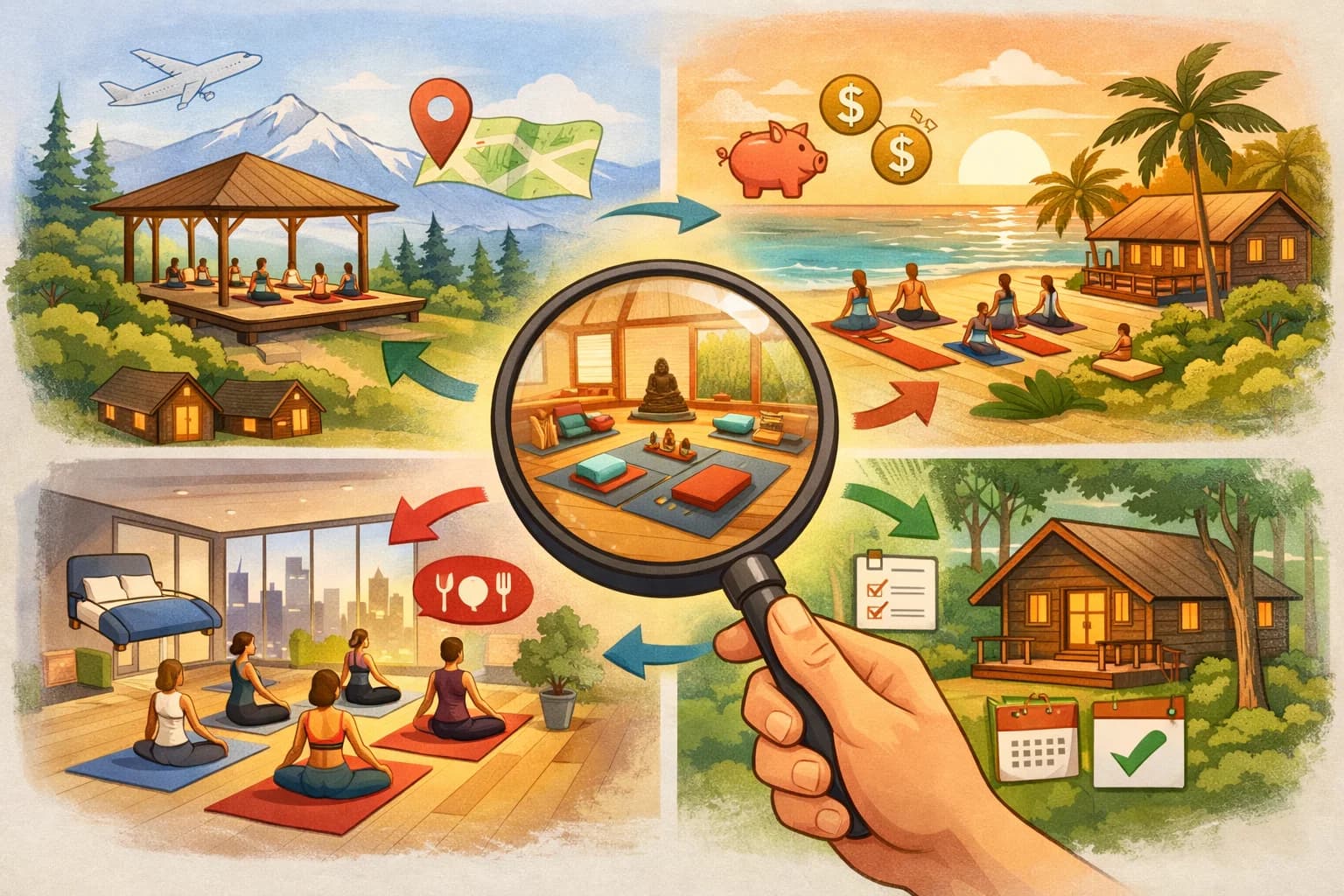
TL;DR: For 15 guests on a 7-day Costa Rica retreat, the best way to take deposits and installments is one booking page that does both: the guest pays a deposit and gives you their details in one step, then their card is charged automatically on dates you set, ending two to three weeks before your venue's final payment. Size the deposit from the venue's deposit, not from a percentage rule. Price in US dollars, get paid to your own Stripe account in your home country, and let US guests pick Klarna, Afterpay or Affirm if they want to spread the cost without you carrying it. The worked example below runs the numbers for a $2,400 retreat.
The best way to take deposits and let guests pay the rest in installments for a 7-day yoga retreat in Costa Rica is to make the schedule the venue's schedule, in reverse. The venue wants a deposit at signing and the balance a month or two before you arrive. So your guests pay a deposit at booking that, added together, covers the venue's deposit, and they pay the balance in automatic installments that finish before the venue's balance is due. Done that way, you never front the venue money, you never chase fifteen people for a payment, and the one or two cards that fail are a system notice, not a crisis.
This guide works the numbers for 15 guests, then covers the parts that are specific to Costa Rica: what venues there usually ask, which currency to price in, how you get paid if you are not based there, and what to collect for arrival day.
What a Costa Rica Retreat Venue Usually Asks of You
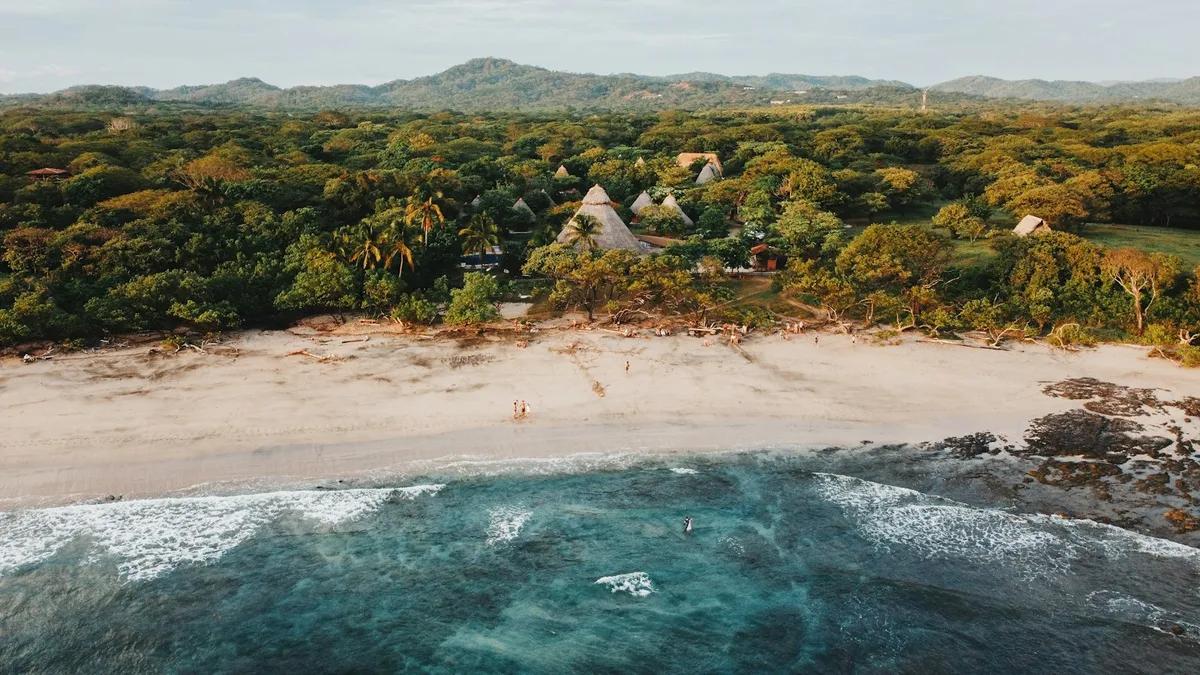
Costa Rica is one of the most common destinations for traveling yoga hosts, and the venues that host them, from a surf-town casa to a jungle retreat center in Nosara, Santa Teresa or the Osa Peninsula, tend to work the same way with international groups:
- A deposit at contract signing, often a quarter to half of the total, and usually non-refundable past a short window.
- The balance 30 to 90 days before arrival, with 60 days the most common date hosts quote.
- A price in US dollars. Most venues quote international groups in USD, which is why you should price your retreat in USD too.
- Minimum and maximum headcounts, sometimes with a per-night rate that changes if you fall short.
- Meals and transfers quoted separately, so your package price has to include what the venue does not.
Read your contract for the two numbers that drive everything else: the deposit you owe at signing, and the date the balance is due. Every number below is derived from those two. If your venue's terms differ, change the inputs, not the method.
Step 1: Size the Deposit From the Venue Deposit
The deposit has one job: cover what you owe the venue before the group is full, so that money never comes out of your own account.
Worked example. A 7-day retreat for 15 guests at $2,400 per person in a shared room (a private room upgrade at $3,000 works the same way). The venue quotes $900 per guest for seven nights of lodging and meals, $13,500 in total, and wants 30% ($4,050) at signing with the balance due 60 days before arrival.
| Input | Number |
|---|---|
| Venue total | $13,500 |
| Venue deposit at signing (30%) | $4,050 |
| Venue deposit per guest (÷ 15) | $270 |
| Deposit you ask each guest | $400 |
| Bookings needed to cover the venue deposit | 11 ($4,400) |
| Balance per guest | $2,000 |
Rounding $270 up to $400 does two things. It covers the venue deposit once eleven people have booked, so you are not waiting on the last few guests, and it is a round number that reads well on a booking page. At 17% of the price it sits inside what organizers actually ask: on the median SquadTrip payment plan the deposit is about 15% of the price, and the middle half of trips ask 10% to 23%, according to data on real group trips. Retreats specifically are priced near $2,000 a head and about 44% of retreat bookings use a payment plan, so expect roughly half your guests to take the installments and half to pay in full.
If your venue wants 50% at signing, the per-guest share becomes $450 and a $500 deposit covers it at 14 bookings; consider $600 so eleven do. If it wants a flat $1,000 to hold the dates, your guest deposit can be as low as the retreat deposit policy guide suggests for refund purposes, because the venue money is covered almost immediately.
Step 2: Schedule the Balance to End Before the Venue's Balance
The last installment is due two to three weeks before the venue's final payment. That gap is what lets the plan run without you.
Worked example, continued. Venue balance due at day −60. Last installment at day −80. Bookings open at day −210, seven months out, which is realistic: travelers on payment plans book a median of 181 days before departure, against 84 days for travelers who pay in full.
| Payment | Due | Amount | Running total per guest |
|---|---|---|---|
| Deposit | At booking | $400 | $400 |
| Installment 1 | Day −180 | $400 | $800 |
| Installment 2 | Day −150 | $400 | $1,200 |
| Installment 3 | Day −120 | $400 | $1,600 |
| Installment 4 | Day −100 | $400 | $2,000 |
| Installment 5 | Day −80 | $400 | $2,400 |
Six payments in total is also what travelers tend to choose: the median payment plan on SquadTrip runs six payments, and 43% of plans run four to six. A guest who books at day −120 gets the same end date and fewer, larger installments, because the schedule is anchored to the venue, not to the booking date. The retreat payment plan calculator builds the schedule for your own price and dates.
By day −80 all fifteen guests have paid $2,400 each, $36,000 in total, and your $9,450 venue balance at day −60 is already in your account.
Step 3: Collect the Details in the Same Step as the Deposit
For a Costa Rica retreat the details you need are mostly about getting people there and feeding them. Collect them at checkout, so nobody can pay without answering and nobody answers without paying:
| At booking | At day −30 | Never by email |
|---|---|---|
| Legal name as on passport | Flight number and arrival time into SJO (San José) or LIR (Liberia) | Card details |
| Email and phone (WhatsApp works well in Costa Rica) | Whether they want the group shuttle | Passport scans you have no reason to hold |
| Room choice or roommate name | Departure flight time | |
| Dietary needs and yoga experience | ||
| Emergency contact | ||
| Acceptance of your terms and a liability waiver |
The airport question matters more in Costa Rica than most places: a guest landing at Liberia when the shuttle leaves from San José is a five-hour mistake. Ask which airport they are flying into at booking, and the exact flight at day −30 through the same system.
Step 4: Write the Terms Before the Page Goes Live
Your refund schedule mirrors the venue's. If the venue refunds nothing after day −60, you cannot either. One page, linked from the booking page and accepted at checkout:
[Retreat name], Costa Rica, [dates] Price: $2,400 per person, shared room ($3,000 private). Includes 7 nights, all meals, daily yoga, airport shuttle from SJO at [time]. Does not include flights, travel insurance or [excursions]. Deposit: $400 at booking, non-refundable after 7 days. Payment plan: $2,000 balance in 5 automatic payments of $400 on [dates]. Your card is charged on each date; you get a reminder 5 days before. Missed payment: a failed charge is retried in 3 days. If it fails again you have 7 days to update your card before your spot is released and the deposit kept. Cancellation: before [day −90] a refund of everything except the deposit; before [day −60] 50%; after that no refund. Travel insurance is strongly recommended. Minimum group: 10 guests by [day −90], or everyone is refunded in full.
The Costa Rica Specifics
Price in US dollars. Your venue quotes in USD, your guests mostly think in USD, and pricing in colones adds a conversion step nobody wants. On SquadTrip you choose one currency for your whole account (US dollars, British pounds or euros) and the retreat is priced in it.
Where you get paid has nothing to do with where the retreat is. SquadTrip sends every payment to your own Stripe account the moment a guest pays; SquadTrip never holds the money. So a host based in the United States, the United Kingdom, Canada or most of Europe connects their normal Stripe account and runs a Costa Rica retreat exactly like a domestic one. Hosts whose business is registered in Costa Rica itself should check Stripe's current country list before counting on it; Square is offered as an alternative gateway but takes card payments only, with no pay-over-time options. The help center has the detail on using SquadTrip outside the US.
Buy now, pay later for US guests. A $2,400 retreat is exactly the size at which guests ask to spread the cost. If your retreat is priced in USD, a US guest can choose Klarna, Afterpay or Affirm at checkout; a 4% convenience fee is added to their total and you are paid the full $2,400 up front, so the provider carries the installments, not you. The guide to BNPL for retreat organizers covers how that sits next to your own payment plan.
Flights stay out of the package. Guests come from different cities and the fares vary too much to bundle. Include the shuttle from one named airport instead, and sell a private transfer as an add-on for guests landing at the other one.
Insurance. Recommend travel insurance in the terms and mean it; a non-refundable venue balance is the reason. Group trip insurance 101 explains what guests should look for.
What to Run It On
For 15 guests paying in full, a Stripe payment link and a spreadsheet would do. Fifteen guests on six-payment plans is 90 scheduled charges, plus the room choices, waivers and flight details, and that is where the do-it-yourself setup breaks: invoices and payment links charge nothing on a due date unless you build the schedule per guest, and they collect no waiver, no room choice and no roommate. You become the payment plan.
A group travel booking platform does the whole workflow as one setup. On SquadTrip you set the packages, the $400 deposit, the registration questions, the waiver and the installment dates once; each guest books through one link, cards are charged automatically with a reminder before each date and a retry after a failure, roommates each pay for their own spot in a shared room, and the rooming and dietary lists export from the bookings. It is free to use: one 6% fee is added to each payment and paid by the guest by default, so the $2,400 retreat costs the guest $2,544 and you receive the full $2,400 in your Stripe account. You can absorb the fee instead and receive $2,256. SquadTrip vs WeTravel compares the two platforms built for this on fees and payment plans, and the five best retreat booking platforms covers the rest of the field.
Whatever you run it on, the method is the same: the venue's two numbers set the deposit and the end date, the guests' cards do the rest, and your month before the retreat goes into the retreat.