
TL;DR:
- To host a retreat: choose a niche and audience, book a venue 3–6 months out, price it on real costs plus a 30–50% margin, open bookings with a deposit and payment plan, collect waivers and registration at checkout, market to your own audience first, then run it and gather feedback.
- Most first retreats work best at 10–20 guests over 3–5 days, priced around $1,000–$3,000 per person.
- The venue deposit is the moment hosts get stuck: take guest deposits before you pay it, and schedule the last guest instalment before the venue's final-payment date.
- SquadTrip handles the booking page, deposits, automatic instalments, BNPL, waivers and group chat for free — guests pay one 6% processing fee and you receive your full price.
To host a retreat, you need to: choose a theme and target audience, find and book a venue (3–6 months out), set pricing that covers costs plus a 30–50% margin, create a booking page with a deposit and payment plan, market through your own audience and social media, and collect registrations and waivers before anyone arrives. Most successful first-time retreat hosts start with 10–20 guests and a 3–5 day format. SquadTrip is a platform designed for retreat organizers, allowing you to create, market and manage your retreat from one dashboard.
The wellness tourism market is projected to reach $2,054.90 billion by 2034 according to Precedence Research, and retreat hosts are the best-performing group of organizers on SquadTrip — the average retreat booking is about $2,400, and the strongest hosts run several retreats a year with repeat guests. Whether you are a yoga instructor, coach, therapist or community leader, here is the step-by-step process, with a deeper guide linked at each step.
Choose Your Retreat's Niche and Who It Is For
Starting a retreat business is a smart way for yoga instructors, coaches and wellness professionals to earn from what they already do. The first decision is not the venue; it is who the retreat is for and what it promises them.
Define the purpose. Are you running a yoga retreat, a healing or transformation retreat, a writing retreat, a couples retreat, a corporate offsite? The clearer the "why", the easier every later decision — and the easier it is to sell. If it's a company offsite, see how to book a company retreat for the corporate side.
Define the guest. Beginners looking for rest need a different retreat from experienced practitioners seeking depth. According to the Global Wellness Institute, wellness travel is growing fastest among millennial and Gen X travellers, so decide which of them you are talking to.
Pick the format. The table below shows where most first retreats land.
| Type | Group size | Venue style | Typical price | Planning timeline |
|---|---|---|---|---|
| Wellness / yoga | 10–25 | Resort, retreat centre, villa | $1,000–$3,000 | 3–6 months |
| Healing / transformation | 12–40 | Villa, boutique hotel | $1,500–$3,500 | 4–6 months |
| Creative / workshop | 8–15 | Boutique hotel, co-working space | $800–$2,500 | 2–4 months |
| Corporate | 15–50 | Conference centre, hotel | $500–$2,000 | 3–6 months |
| Adventure | 8–20 | Eco-lodge, campsite, cabins | $1,200–$4,000 | 4–6 months |
| Spiritual | 10–30 | Ashram, monastery, retreat centre | $600–$2,500 | 3–5 months |
Give the retreat a name that says what it is for. "Reset: A 5-Day Yoga & Breathwork Retreat in Tulum" sells; "Spring Retreat 2026" does not.
Find and Book the Venue (3–6 Months Out)
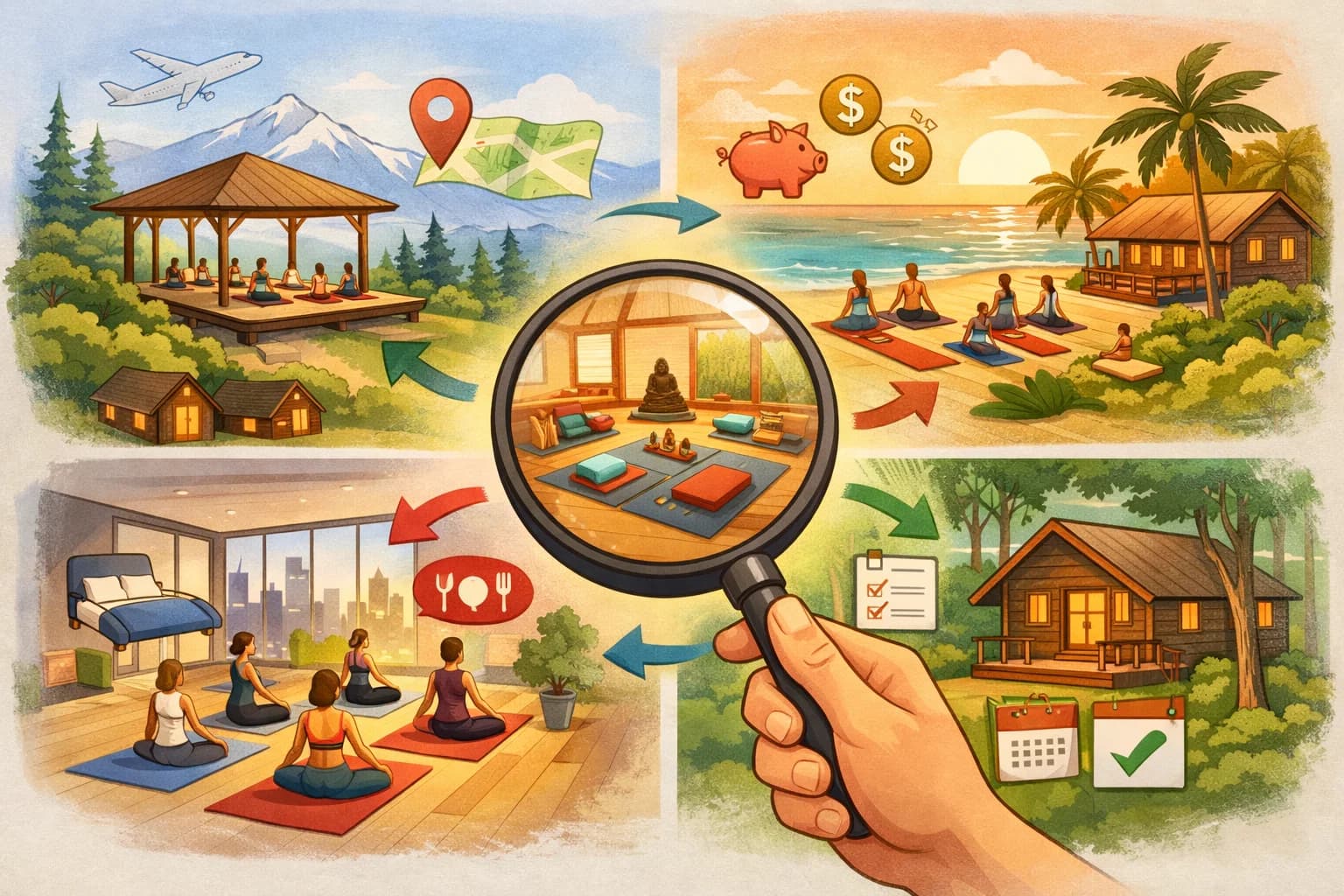
Pick a location your audience can afford to reach and that fits the theme — mountains, beach, forest, a city for a creative retreat. Retreat centres offer all-in-one amenities and are the easiest first venue; villas give more control and usually more margin. See where to host a retreat for how to compare them.
When you evaluate a venue, get three numbers in writing: the total cost, the deposit and when it is due, and the final-payment date. Those dates drive your entire payment plan, because the venue will want money before all your guests have paid you. The hosts who get into trouble are the ones who pay a $9,000 villa deposit on a personal card in March with two bookings in hand.
The fix is sequencing: open bookings and take guest deposits before the venue deposit is due, and schedule the last guest instalment before the venue's final-payment date. If the venue wants 30% at signing, your guest deposit should be at least 30% of the package. More on this in retreat deposit policies.
Price the Retreat and Build the Budget
Pricing makes or breaks the retreat, and most first-time hosts underprice because they leave out their own time, insurance, transfers and a buffer.
The method is three numbers: fixed costs (venue, facilitators, transfers, insurance, marketing), per-guest costs (meals, activities, materials), and your host fee. Divide by the minimum guest count you would still run with, and that is your break-even per seat. Then add a 30–50% margin. Here is a realistic 20-person example:
| Category | Cost |
|---|---|
| Venue (4 nights) | $8,000 |
| Meals and catering | $4,000 |
| Facilitator / instructor fees | $2,000 |
| Marketing and promotion | $1,000 |
| Total costs | $15,000 |
| Ticket price per person | $1,200 |
| Total revenue (20 guests) | $24,000 |
| Net profit | $9,000 |
That is a 37.5% margin before taxes and your own travel. Adjust price and group size to hit your target; most successful hosts aim for 30–50%.
Then package it: an all-inclusive base price, two or three room tiers (shared, double, private), an early-bird price capped at a few seats, and optional add-ons. Tiers raise the average booking without discounting the retreat.
Go deeper: how to price a retreat for the full pricing method, how much it costs to run a wellness retreat for a worked 16-guest budget, the retreat break-even calculator to run your own numbers live, the retreat budget template, and are wellness retreats profitable? for real margin numbers. For the timing between the venue's deposit and your guests' instalments — the point where first retreats end up on a personal card — see the retreat cash-flow problem.
Open Bookings With a Deposit and Payment Plan
Once the price is set, guests need somewhere to book and pay — and you need the money to arrive on a schedule that matches the venue's. Doing this by hand means invoicing each guest for each instalment and chasing the ones who forget; with 16 guests on four payments that is 64 transactions.
A booking page fixes it. On SquadTrip you create the retreat page with the itinerary, packages and add-ons, set the deposit and instalment dates once, and guests book themselves. Each instalment is charged automatically to the card on file, with a reminder before the due date, and your dashboard shows who has paid and who is behind. Guests who cannot pay the deposit today can use buy now, pay later through Klarna, Affirm or Afterpay — they finance, you are paid in full. Funds go straight to your own Stripe or Square account; SquadTrip never holds your money.
It is free to use: guests pay one 6% processing fee on top of your price, which already includes Stripe's card fees, so a $2,000 seat pays you $2,000.
Sixteen guests, four instalments each — collected without you
Set the deposit and instalment dates once. SquadTrip charges each guest on schedule, sends the reminders, and shows you every balance.
Create your retreat booking page freeIf you are comparing platforms, see the best retreat booking and management software and retreat booking platforms compared. If you also want to be discovered by people searching for retreats, list on a marketplace as well — retreat booking sites explains how to use them without paying commission on your own audience.
Collect Registrations, Waivers and Insurance Before Anyone Arrives
The paperwork is easiest at the moment of booking, when the guest is motivated, and hardest at the welcome circle.
Registration form. Dietary needs, room preference, emergency contact, arrival details, experience level. Collect it during checkout so you are not chasing it later — what to include in a retreat registration form has the full list.
Waiver. A liability waiver signed as a condition of paying the deposit is one every guest has signed. Use the clauses in the retreat waiver guide and the retreat contract template for the rest of the agreement, including your cancellation and refund policy.
Insurance. General liability at minimum, professional liability if you instruct, cancellation cover if the venue deposit is large — and check whether your yoga or coaching policy actually extends to a multi-day retreat abroad. Do you need retreat insurance? walks through it. Require guests to carry their own travel insurance and collect confirmation on the registration form.
SquadTrip collects the registration form and e-signed waiver during checkout, so the folder is complete before day one.
Plan the Itinerary
A retreat itinerary is structured around the teaching or transformation content, with enough rest that guests leave restored rather than scheduled. A typical day: morning practice, breakfast, a workshop or session, a long free afternoon or excursion, an evening gathering. Build in one fully open day on retreats of five nights or more.
Publish the itinerary on the booking page — day by day, with times, locations and what is included — so guests can see exactly what they are buying before they book, and can check it from their phone during the retreat. Keep add-ons (a massage, a boat trip) optional at checkout rather than folding them into the base price.
Market the Retreat and Fill the Spots
Most first retreats fill from the host's own audience: students, clients, an email list, followers. Start there, before ads.
- Announce to your list and your regular classes first, with the early-bird price and a deadline
- Share the booking page on social with real photos of the venue and a short video of you explaining who the retreat is for
- Post testimonials from past guests or workshops
- Partner with a studio, a brand or an influencer whose audience matches yours — affiliate links on SquadTrip track who referred each booking
- Create a waitlist for the next one the moment this one is full
The booking page is the landing page: one link, everything a guest needs to decide, and a Book Now button. For the full playbook — channels, timing, what to say when — see how to market a retreat.
Run It, Then Collect Feedback for the Next One
During the retreat, use the group chat for arrival times, what to pack and daily updates so the information lives in one place rather than in a WhatsApp group half the guests muted.
Afterwards, ask every guest what worked and what did not, and ask while the feeling is fresh. Feedback is what turns a first retreat into a repeat business: the hosts who earn most on SquadTrip run the same retreat two or three times a year to a growing list of returners and their friends. Your reporting dashboard shows what you earned and what it cost, which is the budget for the next one — and the export that answers the year-end question, do you get a 1099 for collecting retreat payments?
The Bottom Line
Hosting a retreat is a sequence: niche, venue, price, bookings, paperwork, itinerary, marketing, delivery. Get the money side right — deposits before the venue deposit, instalments before the venue's final payment, a 30–50% margin — and the rest is the part you are already good at.
Ready to host your first retreat? Create your retreat booking page on SquadTrip — deposits, payment plans, BNPL, waivers and group chat, free to use.
FAQs
Are wellness retreats profitable?
Yes, when they are priced on real costs. Retreat hosts who list fixed and per-guest costs, pay themselves a host fee and add a 30–50% margin run profitable retreats, and the best accounts run several a year with repeat guests. Retreats lose money when the price is set on feel, the venue deposit is paid before guests have committed, or the group comes in under the minimum the budget assumed. See our full retreat profitability breakdown with real revenue numbers.
How do you create a budget for a retreat?
List fixed costs first — venue, facilitators, transfers, insurance and marketing — which you pay regardless of headcount. Then list per-guest costs such as meals, activities and materials. Add a 10–15% buffer and your own host fee, divide by the minimum number of guests you would still run the retreat with, and that is your break-even price per seat before margin. The retreat budget template lays it out.
How much does it cost to host a retreat?
Hosting a retreat typically costs $5,000 to $20,000 depending on venue, group size, duration and location. The biggest expenses are venue rental, meals and facilitator fees. Most organizers aim for a 30–50% profit margin above total costs. How much does it cost to run a wellness retreat? works a full example.
How far in advance should I plan a retreat?
Plan at least 3 to 6 months in advance. This gives you time to secure a venue, build a booking page, market to your audience and collect deposits. Longer lead times of 6 to 12 months work better for international retreats or larger groups.
How many people should attend a first-time retreat?
10 to 20 guests is the sweet spot for a first retreat. It is large enough to cover costs and create group energy, but small enough to manage logistics and provide a personal experience. Start small and scale up with future retreats.