TL;DR
-
Travefy is useful, but many tools offer stronger options depending on how you plan and manage trips.
-
SquadTrip leads the list with easy trip pages, clear payment plans and smooth guest tracking in one dashboard.
-
Other platforms focus on visual itineraries, mobile apps, supplier management or full agency operations.
-
This guide helps you compare the top ten choices so you can pick the tool that fits your workflow, scale and client experience.
Introduction
If you’re working in the travel-agent or group trip-planner space and using Travefy (or considering it), you’ll want to know what other tools are out there. Whether you need better branding options, deeper group-trip features, payments & booking integrations, or simply a different user experience this list of ten Travefy alternatives will help you compare and pick what fits.
Explore a simpler Travefy alternative for group trips with SquadTrip.
What to look for in a Travefy alternative
Before diving into products, here are key things you should evaluate:
- Itinerary builder & branding – How easy is it to build custom itineraries with your brand, present them nicely, and distribute them to clients?
- Group & multi-traveler workflows – For group trips, you’ll want features such as shared planning, guest lists, split payments, group communication.
- Booking/payments/CRM integrations – Does the tool integrate with booking engines, payment gateways, handle deposits or group payments, or tie into a CRM so you can track clients?
- Mobile/client experience – Since travelers will use the tool on the go, how good is the mobile or web client interface? Offline access, notifications, update syncs matter.
- Scalability & cost – If you run many group trips, you’ll want a tool that scales (users, groups, languages, currencies) without exploding your cost.
- Support & ecosystem – Is the provider travel-industry focused, with specific travel-agent support, templates, training, and partner relationships?
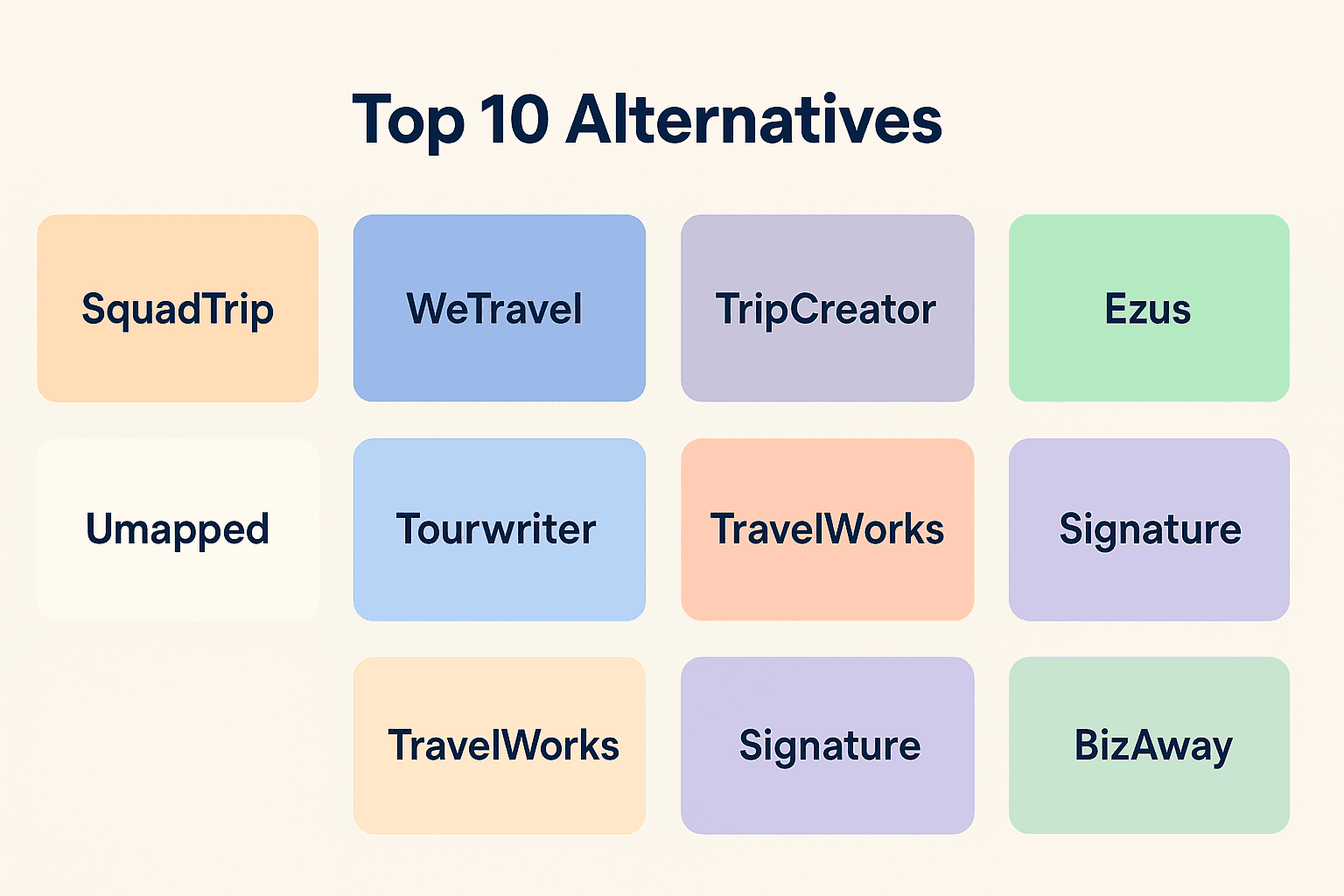
Top 10 Alternatives
1. SquadTrip
SquadTrip is built for organisers who run group trips, retreats or community events and want an easier way to handle bookings, payments and guest management. Instead of juggling spreadsheets or asking guests to pay through multiple channels, everything happens in one place. You can create a clean trip page, set custom payment plans, track each attendee’s status and see all booking activity in your dashboard. It also supports packages, add-ons and automated reminders so guests never miss a due date.
Why choose it: Simple setup, clear payment plans, and a guest dashboard that keeps everything organised. Good for organisers who want to launch trips quickly without complicated tools.
Trade-off: It focuses more on planning and payments rather than itinerary design or advanced vendor integrations.
2. WeTravel
WeTravel is one of the most recognised platforms for group-travel businesses because it focuses heavily on payments, bookings and traveller management. Many tour operators, retreat hosts and multi-day travel organisers prefer it when they need a system that handles everything from deposit collection to instalments and refunds. The platform also gives you a central dashboard to monitor guests, packages and trip finances.
Why choose it: Strong payments and group-trip management features. Ideal if your trips involve multiple travellers paying in different phases.
Trade-off: Itinerary-branding options may be lighter than tools designed mainly for visual itineraries.
3. TripCreator
TripCreator offers a structured approach to both itinerary creation and back-office operations. It helps you build detailed itineraries using drag-and-drop tools and also lets you manage bookings, suppliers, currencies and internal agency workflows. It’s suited for teams that want a single workspace for trip building and operations without using multiple software tools.
Why choose it: Balanced tool for agencies that want itinerary design plus payments, booking support and multi-currency features.
Trade-off: The traveller-facing mobile experience may not feel as modern as others.
4. Ezus
Ezus is designed for tour operators and agencies that manage complex trip logistics. It offers tools for activity booking, supplier coordination, document creation, and detailed budgeting. Instead of focusing solely on itinerary visuals, Ezus supports the operational side of running trips, which is useful if your business handles tours, experiences, or multi-step planning.
Why choose it: Good for agencies that want a strong planning and operations backend, not only itinerary visuals.
Trade-off: Setup can take time and may be better suited for medium to large agencies.
5. Axus Travel App
Axus is well known for its traveller-facing mobile experience. Its interface is clean, easy to navigate and designed for guests who need constant access to trip updates, reservations and itinerary changes. Agents can collaborate internally, share updates instantly and deliver a modern mobile app that clients can use before and during their trips.
Why choose it: Perfect if your priority is a polished, modern, mobile-first experience for clients.
Trade-off: May not include deep booking or payment workflows.
6. Tourwriter
Tourwriter is designed for agencies that build detailed itineraries with many moving parts. It supports FITs, group itineraries, supplier management, and complex configurations that typical trip planners may not handle. If you deal with multi-day, multi-segment travel with multiple pricing layers, Tourwriter offers the depth you’ll need.
Why choose it: Best for agencies handling complex, custom itineraries or managing large travel products.
Trade-off: Can feel overwhelming or expensive if your needs are limited.
7. TravelWorks
TravelWorks is a broader travel-agency management platform that goes beyond itinerary creation. It includes CRM tools, booking management, financial tracking, supplier coordination, and reporting. It’s built for agencies that need an all-in-one system to handle client management and back-office work.
Why choose it: Ideal if you want a full travel-agency platform instead of just an itinerary builder.
Trade-off: Might be too feature-heavy for travel planners handling smaller groups.
8. Signature
Signature appears often in software-comparison listings because it offers tools for tour operators and DMCs, including booking management, dashboards, and supplier workflows. It’s made for businesses that require more operational control and want a system that supports both planning and management.
Why choose it: Strong back-office tools and reliable support for agencies that work with structured tours.
Trade-off: More suited for tour operators than small-scale group-trip planners.
9. BizAway
BizAway is popular among agencies that handle corporate travel or mixed-use trips. It offers booking tools, reporting, budget controls and quote management, making it a strong choice for agencies managing business clients and group travel simultaneously.
Why choose it: Great if you also work with corporate teams or need an all-in-one booking system.
Trade-off: Stronger on corporate travel than leisure-focused group itineraries.
How to pick the right one for your business
Here’s a step-by-step mini-framework you (as a travel agent or group trip planner) can use:
-
Define your core need
- Are you mostly doing branded itineraries for small groups (5-20 people)? Then focus on presentation, mobile experience, ease of use.
- Are you handling large groups (50+), multi-booking payments, many vendors? Then booking/payment integrations or agency-operations support matter more.
-
Map your must-have features
- Itinerary builder + branded output
- Mobile app / traveller portal
- Group payments / split payments
- Booking/CRM integration
- Multi-currency / multi-language
- Supplier/vendor management
- Reporting/analytics
-
Shortlist 2-3 tools and test
Use free trials or demos. Build the same itinerary or trip in each tool and compare:
- How fast does it feel?
- How flexible is the branding?
- How good does the traveller app/portal look?
- How does the payment workflow work?
- What will it cost you monthly/annually for your volume?
-
Check scalability and cost
Especially important if you plan to scale group trips or add sub-brands. A cheaper tool now may cost more later or lock you in.
-
Consider support and partner integrations
If your business uses certain booking engines, supplier networks, or you’re working with global clients, check integrations and travel-industry pedigree.
-
Think about branding & client experience
Your clients/bookers expect slick, professional output. If the software output looks amateur, it may hurt your brand even if internally it works.
My recommendation (from your SaaS marketing angle)
Since you specialise in SaaS marketing and likely appreciate workflows, automation and branded experiences, here are my picks based on typical needs:
- If you focus on group-trip planners who want a slick traveller-facing experience: Try Axus.
- If your clients are travel agents/SMB agencies who need bookings and payments: WeTravel or TripCreator.
- If you serve larger tour operators/DMCs with complex trips: mTrip or Tourwriter.
In your messaging and content (as you target SaaS for travel agents) you can highlight: “Built for travel pros who want more than basic itineraries – choose your tool based on scale, group size, payments and traveller-experience.”
Final thoughts
Choosing the right Travefy alternative comes down to how you manage bookings, payments, itineraries, and guest communication. If you want something that keeps everything simple for both you and your travelers, look for a tool that reduces back-and-forth, handles payments smoothly, and gives guests a clear way to stay organized before the trip. If you want an all-in-one platform built for group trips, SquadTrip makes planning easier with payment plans, guest dashboards, itineraries, and automated reminders so nothing gets missed. Try SquadTrip to make your next trip smoother and more organized.
Manage group trips and payments easily with SquadTrip
FAQ
1. If I’m already using Travefy, why should I even look at alternatives?
Travefy is useful but many tools offer stronger options depending on how you plan and manage trips. For example: some alternatives give better payment and booking workflows; others focus on clean itinerary design, agency-level backend operations, or guest-facing user experience.
2. If I handle small group trips (say 5–20 people), which tool types should I consider?
For small–to–mid-size groups with emphasis on trip design and ease of use, lighter tools with good traveller-facing UI and branding rather than full enterprise booking systems tend to make sense.
3. Do the Travefy alternatives on this list support payment plans for guests?
Some do, some don’t. If payment plans are a big part of your booking process, it’s important to check whether the platform automates due dates, reminders, and transaction tracking.
4. What features should a group-focused travel agent absolutely not compromise on?
Payment tracking, guest dashboards, communication tools, a clean itinerary builder, and the ability to automate reminders. Missing any of these usually means more manual work.
5. Do these alternatives integrate well with my existing booking or CRM tools?
Some do, especially the more advanced ones. It depends on whether you need calendars, Zapier, Google Sheets, or payment gateways connected to your workflow.